Mysteries outside the city and crises within the city
The Sphinx threatens Thebes with a riddle. After Oedipus answers it, he gains the throne and becomes a trusted savior. A common riddle asks why a creature uses four, two, and three legs at different stages. The answer points to human infancy, adulthood, and old age when walking with a staff. The complete riddle form mainly comes from mythological collection and other materials. It cannot be thought that Sophocles's play begins with a question and answer scene. When Oedipus Rex opens, this victory was already a thing of the past.
The confidence created by success
The experience of solving puzzles makes Oedipus believe that he can solve the disaster of the city-state through inquiry, reasoning and action. When the plague reappears, he strives to uncover the truth behind the murder of his predecessor, King Laius. There is a real public responsibility to such an investigation, and it also involves reliance on one's own judgment. Audiences gradually discover that being able to solve an external problem does not guarantee recognition of one's own experience. Past achievements can provide motivation for continued action, but they can also make it difficult to accept evidence that challenges established identities.
The investigator walks into his own story
The witness’s statement, the messenger’s news and the story of his childhood origins gradually interlocked with each other. Oedipus finally realized that the murderer he was looking for was himself, and his marriage was within the prophecy that he originally tried to escape. Tragedy does not simply equate ignorance with stupidity: characters make serious attempts to avoid disaster, but lack all the information to understand those attempts. The clearer the understanding becomes, the more choices that seemed reasonable in the past take on another meaning, and the truth is no longer just an enemy that can be defeated from the outside.
Confrontation and pause in painting
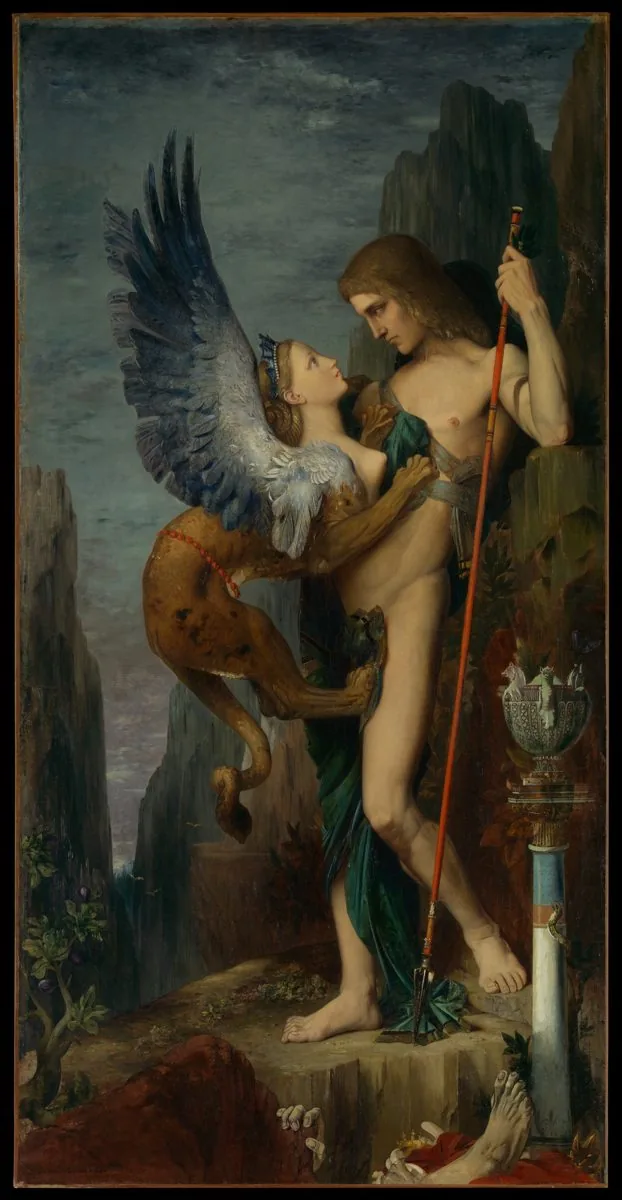
Painters such as Moreau center the moment when the Sphinx comes face to face with the young hero, highlighting the physical tension of the mystery as it remains unsolved. These modern works present the early stages of the myth, not the self-mutilation scene at the end of the play. Juxtaposing the two, one can see the distance between wisdom and self-knowledge. The riddle of the Sphinx ultimately points to human life, and Oedipus' own fate also forces him to re-understand that a person's general knowledge of human beings may not necessarily equal the complete knowledge of his own life.