Where to go when the search fails
Cadmus does not originally leave home to found a city. Zeus, disguised as a bull, has carried away his sister Europa, and their father Agenor orders his sons to find her before returning. In Book 3 of the Library, the unsuccessful search scatters the family. After burying his mother Telephassa, Cadmus consults Delphi. Apollo changes his task: stop searching for Europa, follow a cow, and found a city where she lies down from weariness. Ovid also begins Book 3 of the Metamorphoses with this change of direction. A journey defined by a father’s command becomes a search for shelter on foreign ground. The oracle offers direction, but no ready-made, secure home.
Water for a sacrifice brings death
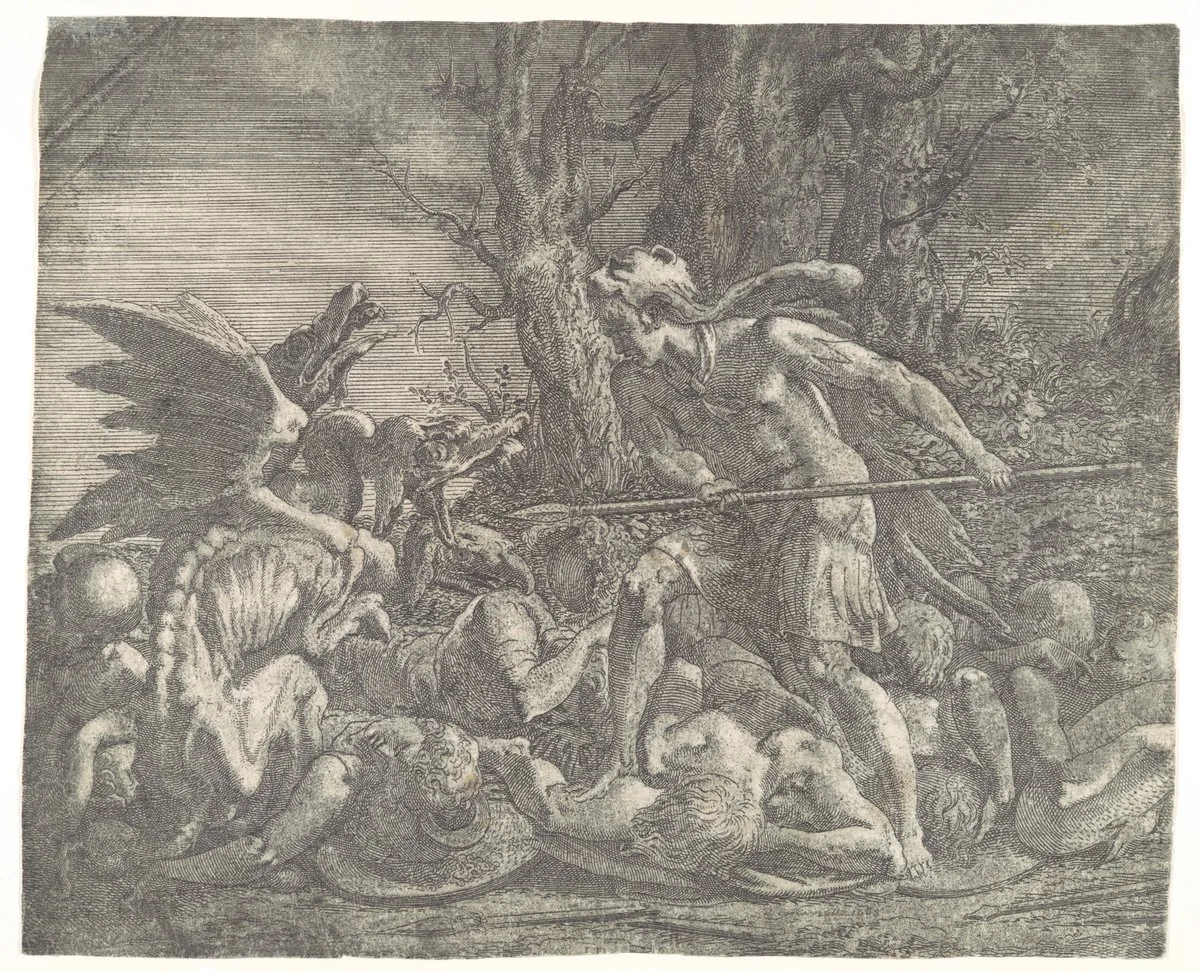
When the cow stops, settlement seems possible, but a sacrifice requires water. In the Library, Cadmus intends to sacrifice the cow to Athena. A great serpent guarding the spring of Ares kills most of the companions sent to fetch water. Ovid instead has Cadmus prepare a sacrifice to Jupiter, and all the water carriers die. The recipient and casualties should remain distinct. Both accounts bring a ritual of establishing relationships into conflict with another god’s possession. Discovering the bodies, Cadmus kills the serpent. Ovid expands the struggle through a thrown stone, a javelin, and a spear that pins its neck against a tree. This dragon is a great snake; wings and fire need not be added.
Armed men are not yet neighbors
Athena tells the victor to sow the serpent’s teeth. Ovid makes their growth resemble a theater curtain rising from below: spear points and helmets appear first, then shoulders, chests, and weapons. These newcomers are fully armed before experiencing any shared life. Cadmus prepares to defend himself, but one tells him to stay out; the warriors kill one another. The Library also cites another account, attributed to Pherecydes: Cadmus throws stones, making them mistake each other for attackers. That trick is absent from Ovid’s passage. Whichever account we follow, people produced by the land do not immediately become neighbors. Birth in the same place has supplied neither mutual knowledge nor a reason to trust.
Five survivors become companions
Only five remain. In Ovid, Echion receives Minerva’s warning, urges his surviving brothers to stop, and first lays down his own weapons as a pledge. The five then become Cadmus’ trusted companions in building the city. The Library preserves their names: Echion, Udaeus, Chthonius, Hyperenor, and Pelorus. They are the Spartoi, the sown men. This is not Jason’s field in Colchis, where a king sets a dangerous test, nor does it end with every warrior destroyed. The city needs those who remain. Ending violence precedes working together. Founding therefore means more than a hero finding a location: former opponents must begin to believe that they can inhabit it together.
Victory still carries an obligation
Killing the guardian does not free Cadmus from Ares. The Library makes him serve the god for a great year, explained as eight human years. Afterward Athena secures his kingship, and Zeus gives him Harmonia, daughter of Ares and Aphrodite, as his wife. We need not insert these arrangements into every silence in Ovid. They reveal another concern: victory still carries a debt. A wedding attended by gods and the founding of a city cannot guarantee descendants a life without tragedy. Returning to the beginning, we might remember not how quickly teeth become people, but the moment when Echion lowers his weapons. After force has caused harm, a community needs another way to continue living. The story also changes the shape of belonging: a traveler barred from returning home and people born only moments earlier must learn to call the same place home. Neither an inherited address nor a miraculous birth has settled that task for them.