A mother whose name poses a question
The Theogony names Mnemosyne among the daughters of Earth and Heaven, then makes her the mother, by Zeus, of nine Muses. Her name means Memory; her daughters enter Olympus through song and dance. Giving an ability a family relationship is one way this poem thinks about the world. Song involves preservation, retrieval, and arrangement rather than appearing from nowhere. We need not immediately distribute nine names across nine modern school subjects. Hesiod chiefly presents voices responding together, and later connects their gifts with public speech. A genealogy therefore does more than answer who gave birth to whom: it places an activity beside a related capacity.
A troubling statement before the laurel staff
While tending sheep beneath Helicon, Hesiod meets the Muses who teach him song. They first dismiss shepherds as people concerned with their bellies, then declare that they can tell false things resembling truth, and true things when they choose. This is no checklist labelling every subsequent line true or false. They give him a laurel branch as a staff and a voice for celebrating the immortal gods, commanding him to begin and end with the Muses. Authorisation and a reminder of uncertainty share one encounter. A beautiful voice does not make a poet omniscient. Readers, too, can attend to who claims knowledge and who gives that claim its power.
Memory’s daughters also loosen sorrow
The opening contains an apparent paradox: song born of Memory can bring forgetfulness of pain. Hesiod describes someone troubled by grief who hears a singer recount earlier human deeds and the gods, and turns away from a personal burden. The poem does not erase the past or make Mnemosyne an enemy demanding universal amnesia. Attention gains room to move; one sorrow no longer fills the present, and other lives and times enter it. This is a hymnic account of song’s power, not a therapeutic promise that every listener will experience an identical result. Remembering and temporarily escaping confinement within one concern can belong to the same imaginative arrangement.
Preservation is more than invisible storage
In their introduction to Music and Memory in the Ancient Greek and Roman Worlds, Lauren Curtis and Naomi Weiss explain that ancient mousikē includes song, dance, and instrumental music. Memory participates in performance and is shaped by it; its dimensions are bodily and communal, not simply sentences stored inside a mind. Returning to Hesiod with this perspective, we need not reduce the mother and daughters to a poet’s good recall. Ordering a list, singing a name again, or repeating a movement gives the past a form. Transmission consequently involves selection. Preserving one account does not establish that other voices never existed: continued sound requires particular performers, places, and audiences.
Three Muses have names of their own
Discussing Helicon, Pausanias records a local tradition in which the first honoured Muses numbered three, with names associated with Practice, Memory, and Song. He next reports Pierus establishing nine and records a distinction between older and younger generations of Muses. This much later travel account is not an origin of religion we have personally witnessed. Nor should its three simply become Hesiod’s nine sisters with six missing. These are different numbers and organising schemes. Set beside one another, the combination becomes especially clear: doing something repeatedly, allowing it to remain, and making it audible again are connected activities. The differences help rather than obstruct our reading.
A relief gives song another contest
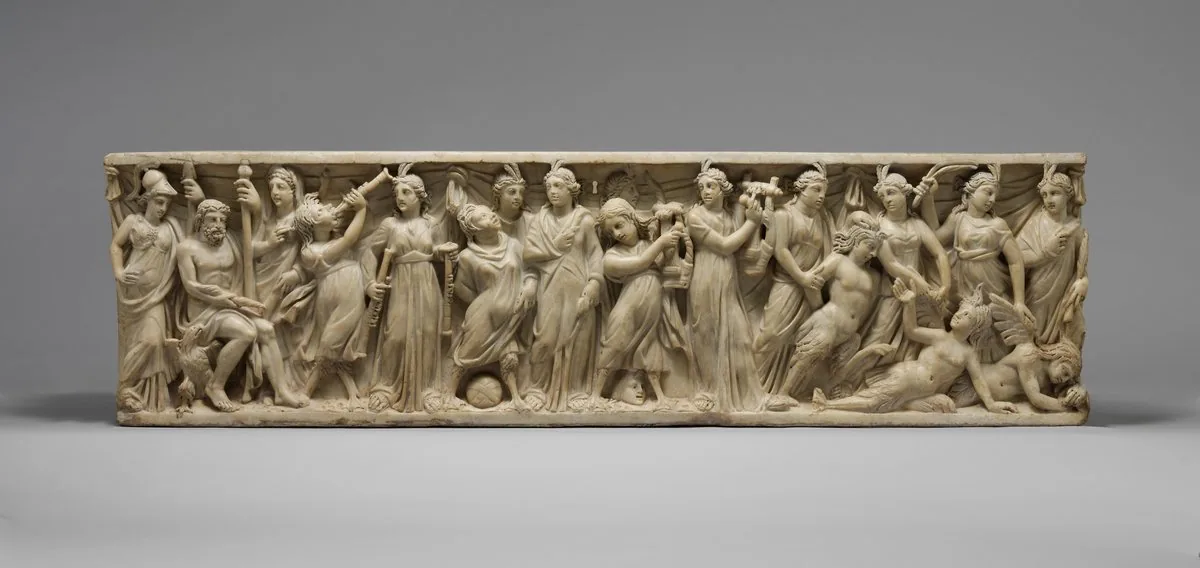
The accompanying image shows the Muses competing with Sirens on a Roman marble sarcophagus, dated to the third quarter of the third century CE. The Metropolitan Museum identifies Athena, Zeus, and Hera presiding at the left, while the Muses defeat their half-bird rivals. This is not Hesiod’s initiation in the Theogony, and its figures cannot simply be identified as Mnemosyne. A later image chooses competition to arrange artistic ideals and different kinds of vocal power together. Back beside the laurel staff, victory has not answered every question: how does a song persuade, what deserves preservation, and how can resemblance be judged? Memory’s daughters open a road for stories while asking us to attend carefully to its voices.