A guest under suspicion
In Book 1 of Ovid's Metamorphoses, Jupiter tells the assembled gods about a journey made in human disguise. Reports of wrongdoing have reached him, and he visits the earth to see whether they are true. At the Arcadian home of Lycaon, some people recognize a divine visitor and pray. The ruler responds differently: he proposes to test whether this guest really is a god. The scene begins with a question of recognition, but it soon reveals a more serious failure. Lycaon treats another person's body and his guest's safety as instruments for satisfying his own certainty.
The meal that breaks hospitality
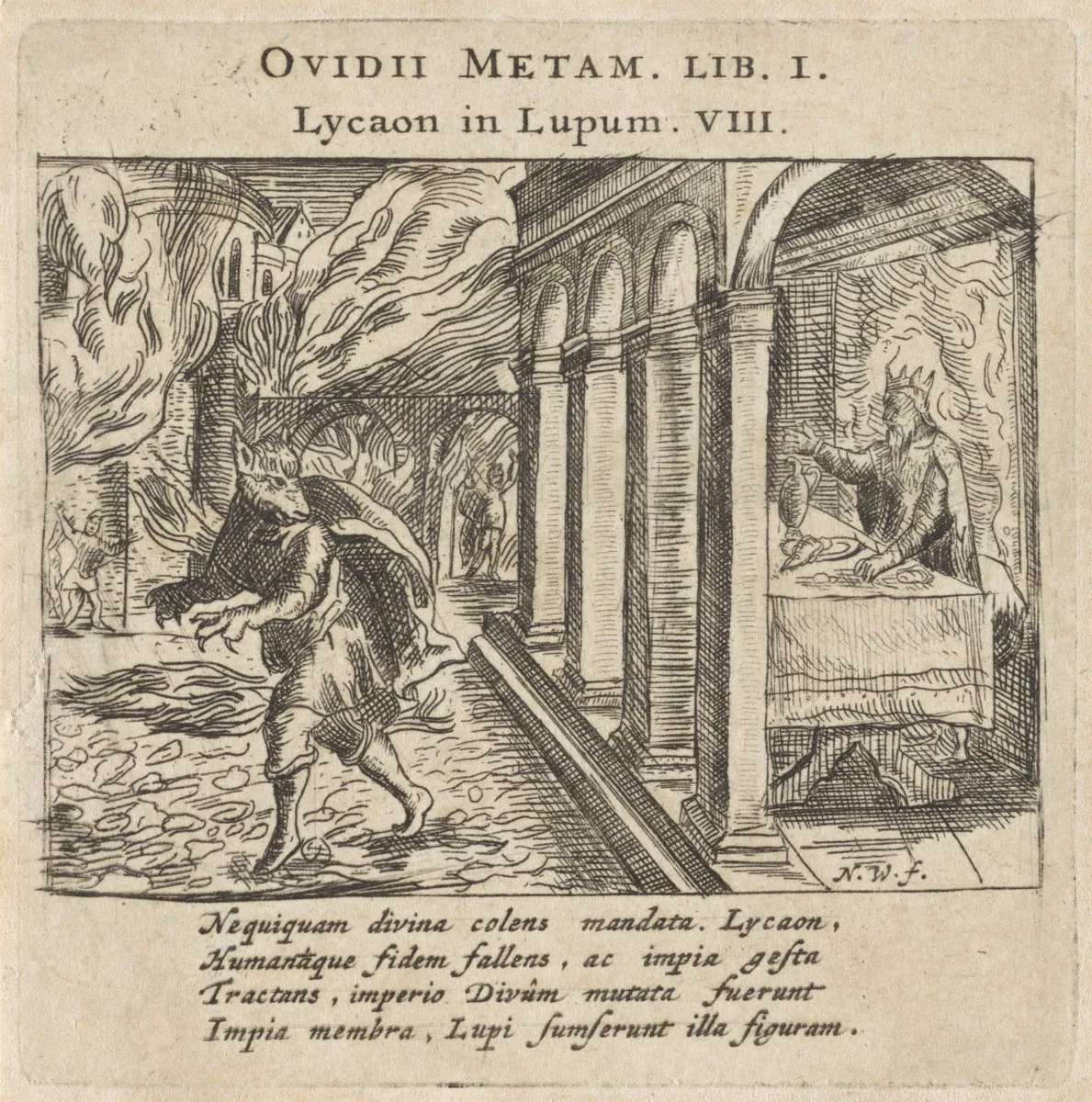
Lycaon plans to kill the visitor in his sleep and serves human flesh at the table. Ovid identifies the victim as a Molossian hostage, not as Arcas, and not as a child whose identity every ancient writer agreed upon. That distinction matters because later retellings often combine different versions. Jupiter destroys the house with his thunderbolt, while Lycaon escapes into the countryside. The account is disturbing without requiring a detailed description of the meal. Its central reversal is clear: a house that should protect a guest has become the place where the host arranges violence and calls it an experiment.
A shape with familiar features
As Lycaon tries to speak, howling replaces human language. His clothes become hair and his arms become legs, yet Ovid emphasizes features that remain: the grey colouring, fierce eyes, and threatening expression. The wolf does not arrive as a completely unrelated disguise. It makes visible the appetite and aggression Jupiter's story has already attributed to the ruler. This is a reading of Ovid's particular imagery, not a claim that real wolves are morally corrupt. The poem uses an animal transformation to connect an outward appearance with actions performed while the man still possessed human speech and royal authority.
Pausanias tells another version
In Description of Greece 8.2, Pausanias associates Lycaon with the foundation of Lycosura, the title of Lycaean Zeus, and the Lycaean games. His account of the transformation concerns a human sacrifice at an altar, followed immediately by the change into a wolf. It is not Ovid's disguised visitor and dinner scene. Pausanias also discusses later stories about temporary wolf transformations and warns that people can spoil a credible tradition by adding marvels. His belief in Lycaon's ancient story sits beside his suspicion of elaboration. We should preserve that combination rather than presenting him as either a modern sceptic or an uncritical collector of every claim.
Reading the ruler and the narrator
Ovid places Lycaon's story inside Jupiter's argument for punishing a wider human world. That frame invites attention as well as the memorable animal body. The god is both the endangered guest and the speaker explaining his judgement before an audience. Pausanias, meanwhile, places the ruler within Arcadian places and remembered institutions. Neither arrangement is a historical record proving that a man physically became a wolf. Read together, they show how a transformation can organize questions about power, hospitality, sacrifice, and the authority of someone telling the past. Keeping their differences visible makes the myth richer than a single warning about becoming a beast.