Begin with the storyteller
Tithonus does not tell the story of his aging himself in the Homeric Hymn to Aphrodite. Aphrodite tells it to the mortal Anchises, who has just recognized her divine identity. He fears that sleeping with a goddess will harm him, and her reassurance turns toward the distance between human beings and immortals. The lover of Eos becomes a warning within their conversation, rather than the subject of a separate romantic biography. Identifying this setting matters: we hear a goddess explaining why she would not wish the same future for her own mortal partner. The story concerns Tithonus's body and Eos's decisions, but also Aphrodite's understanding of the relationship before her. Beauty may attract a god without giving a human the conditions of a god's life.
What the request leaves out
Around lines 218–224, the hymn describes Eos, the goddess of dawn, carrying off the godlike Tithonus and asking Zeus to let him live forever. Zeus grants the request. She has not also asked that he keep his youth and escape old age. The distinction between those wishes drives the story: ending death does not necessarily end bodily change. The poem attributes the omission to Eos's failure to consider it; this passage does not show Zeus secretly altering the terms or Tithonus making the request himself. Retelling it as a deliberate verbal trick by Zeus, or a punishment actively sought through mortal greed, adds motives the hymn does not provide. The unsettling point is that the wish succeeds, while the loss it sought to prevent continues in another form.
Care behind a closed door
In his youth, Tithonus lives with Eos beside Ocean at the ends of the earth. His first gray hairs alter their intimacy: she leaves his bed, but keeps him in her house with food, ambrosia and fine clothing. Eventually the poem describes a weakness so complete that he cannot raise his limbs. Eos places him in a room and closes the doors. His voice continues, although his body no longer has its former strength. These domestic details make the story more than a puzzle about wording. Material provision does not erase isolation, and continuing to live does not guarantee participation in a shared life. We can ask whether care still includes company and response without inventing a reconciliation. The ending does not explicitly transform him into a cicada; discussing that change requires evidence from another tradition.
Another poem opens a morning
At the beginning of Odyssey Book 5, Dawn rises from beside Tithonus to bring light to gods and mortals. This brief opening does not retell the request, the gray hair or the closed room. Instead, the couple forms a familiar background to morning. It need not be treated as an episode occurring after the hymn's tragic ending, as if the works supplied a seamless shared chronology. Comparison reveals how the same names perform different tasks: the epic opens a day, while the hymn exposes a difference between human and divine lives. Dawn returns, but the mortal body does not recover through that repetition. That contrast is something readers can explore, rather than a single message both authors explicitly announced.
Looking at a departure
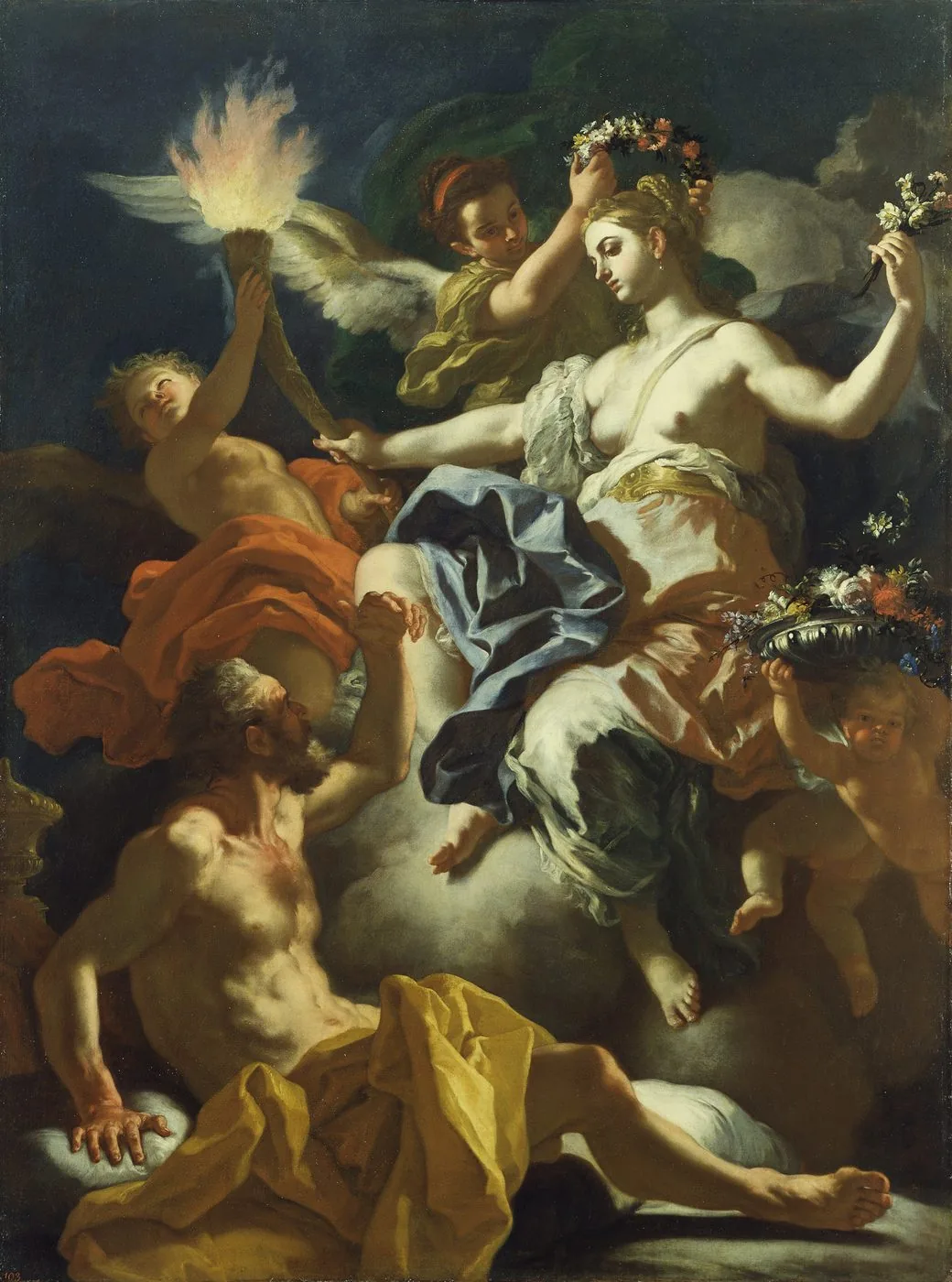
Francesco Solimena's 1704 painting Aurora Taking Leave of Tithonus brings a youthful goddess, flowers and fire into the same scene as an older man looking up toward her. The Getty painting is a later artistic selection from ancient mythology, not a direct record of the hymn. Its rising movement lets departure and remaining behind occupy one view; divine splendor does not make the aging body disappear. The story need not end for us with a reminder to word wishes carefully. What do we want to prolong: time, vitality or the possibility of sharing life with someone? This is no ancient medical or personal prescription, but an exercise in distinguishing different needs. Keeping them separate helps explain why Tithonus receives immortality without the happiness his lover's request seemed to promise.