Peace has Justice and Order beside her
Eirene’s name means Peace. In Hesiod’s Theogony, beginning at line 901, she belongs to the Horai, daughters of Zeus and Themis, alongside Eunomia and Dike. Their names connect good order, justice and peace; together they attend to mortal affairs. This genealogy offers no hero killing a monster. Instead, it places several conditions of shared life beside one another. Peace is therefore more than an interval of rest detached from public concerns. Yet divine kinship is not a diagram of modern political institutions, nor evidence that every ancient city adopted identical ideas. We can first notice how the poet arranges the names, then ask how their relationships help people continue living together.
What kind of city can harvest?
Works and Days, lines 225–237, pictures a flourishing city whose people judge residents and strangers fairly. Peace nurtures children in their land; grain, wool and honey abound, and work in the fields continues. What matters includes how judgments treat outsiders and whether people can wait for crops to ripen. Harvest requires time, which continuing harm can take away. This is a poetic vision of justice, not an economic rule for measuring the virtue of actual societies. Poverty, war or a failed harvest cannot prove that those suffering have done wrong. Following the poem’s fields, we might instead ask how a community protects work and lives whose results cannot appear immediately.
The child does not acquire a different birth mother
Ploutos turns wealth into a child who can be held. At Theogony 969 onward, he is born to Demeter and Iasion after their union in a field ploughed three times on Crete. The grain goddess’s son thus carries an association with agricultural abundance. We should not turn this Ploutos into Hades, also called Plouton, merely because the names resemble one another. Nor does the goddess holding him in a sculptural group replace Demeter as his birth mother in that genealogy. An image can express nurturing, protection and dependence without rewriting parentage. When wealth appears as young life, possession ceases to be the only relevant action. Care, waiting and room for growth become important too.
Pausanias describes two embraces
Pausanias, Description of Greece 9.16.1–2, first discusses Tyche carrying Wealth at Thebes. He admires the artists’ suggestion that Fortune is the child’s mother or nurse, then praises Kephisodotos’s conception of Peace carrying Wealth for the Athenians. Similar poses can propose different relationships; a child alone does not identify the two goddesses as one. The traveler’s praise need not become a statement attributed to every Athenian. Another Roman copy survives as an infant at Athens’ National Archaeological Museum, with its goddess lost. The museum interprets the group as a wish for Peace to nurture abundance and the city’s future. A child, unlike money imagined safely stored, makes vulnerability unmistakable: the future is not finished simply because someone has acquired it.
A fragment teaches us to distinguish seeing from knowing
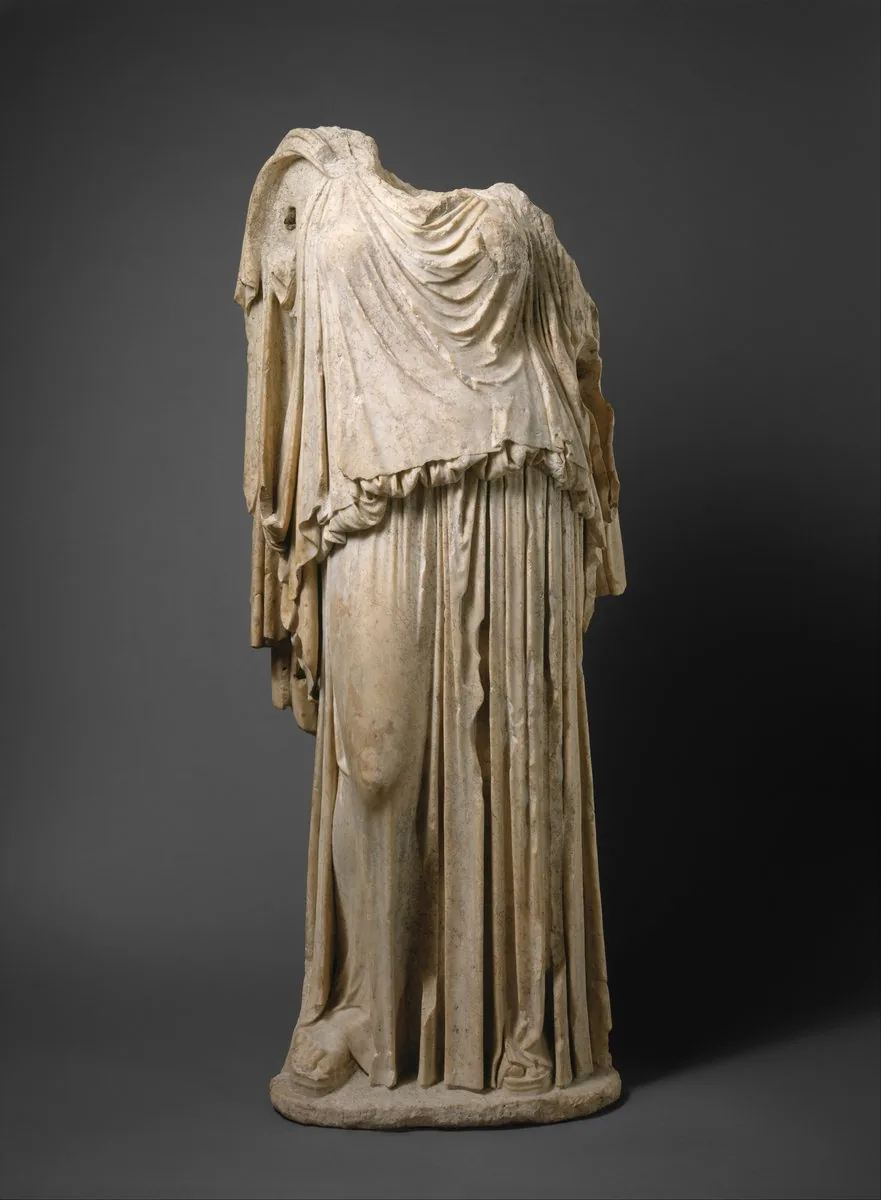
The accompanying Met photograph shows a Roman marble Eirene made around 14–68 CE, not the original Greek bronze at Athens. Her head, arms and the infant are missing; the complete embrace known from texts is not still visible here. Other copies and ancient descriptions help recover the composition. The famous Munich group has also undergone restoration, and Cambridge’s collection catalogue cautions that its child’s head may not belong. Recognizing these distinctions does not diminish Peace. It makes looking a patient task: what survives, what requires comparison, and what remains uncertain? Returning to the adult and child, we can carry away a question about maintenance. Conditions that make life abundant need continuing care, beyond the completed monument a community erects after proclaiming victory.