Begin with a person beside an Athenian river
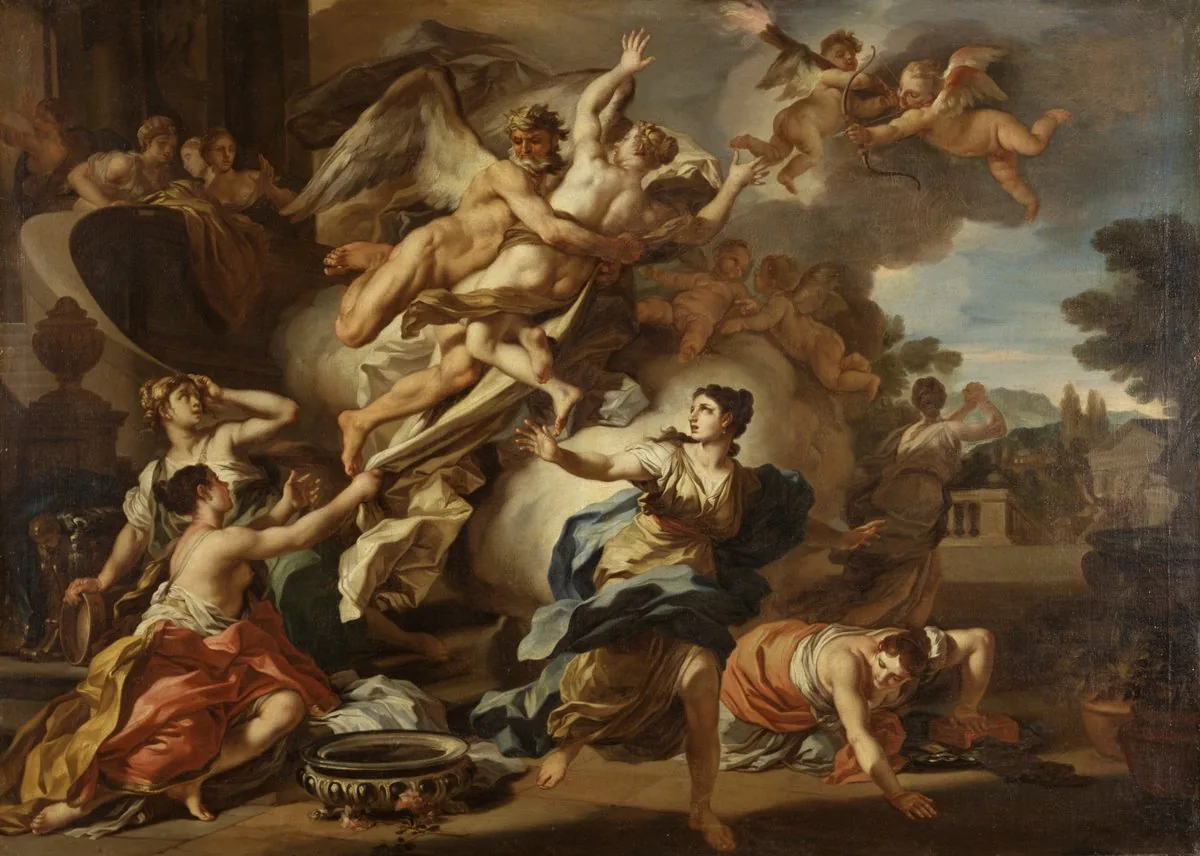
Oreithyia is first a person with a family and a home. The Library 3.15.1 names her among the daughters of Erechtheus, king of Athens, and Praxithea. The following section says that Boreas carried her off while she was playing beside the Ilissus and subsequently had intercourse with her. A few genealogical sentences move a life away from Athens without giving the young woman a choice about leaving. Boreas personifies the north wind; he is not simply an ordinary suitor with a picturesque name. Nor does the riverbank have to become the setting for a secret meeting arranged by both parties. The text supplies her previous location and a power that removes her from it. It supplies no welcoming answer from her.
When persuasion fails, the wind praises force
Ovid’s Metamorphoses 6.675–721 expands the wind god’s action through a dangerous argument. In the aftermath of the Tereus story, associations with Thrace obstruct his courtship. Boreas has initially used petitions and gentle language, without success. He then blames himself for setting aside his characteristic strength and lists what that strength can accomplish: driving clouds, disturbing the sea, uprooting trees, scattering ice and snow, even entering the earth and shaking it. The narrative grants him a substantial speech, but his words do not become Oreithyia’s wishes. Moving from the ability to move forests and waters to the right to determine a person’s destination requires a connection he never establishes. While reading, keep track of who praises force: it is the god preparing to use it.
The person carried through the air is trembling
Boreas unfolds his wings, whirls dust around mountain summits and covers his approach in darkness. He seizes the trembling Oreithyia and carries her to the walls of the Cicones. That is Ovid’s stated destination, within a Thracian geographical setting; this passage does not name the Ilissus as the point of departure, as the Library does. Reading the accounts together does not produce an exact ancient flight map endorsed by every author. It certainly does not make her fear into willingness. Ovid subsequently calls her a wife, but the language of marriage cannot retrospectively supply the missing consent to her removal. The speed belongs to Boreas; the consequences also belong to the person whose life he changes and whose voice receives far less space.
A genealogy records children without supplying consent
Children follow. Ovid says the twins Zetes and Calais inherit their father’s wings and their mother’s appearance. They have no feathers at birth; wings develop when they reach the age of growing beards, and they later join the Argonauts. The Library 3.15.2 instead names daughters Cleopatra and Chione alongside the two winged sons, without reenacting Ovid’s account of their growing wings. The authors have not given identical descriptions of that process. Nor must this episode become a retelling of every subsequent adventure of the brothers. Genealogy connects the abduction to the heroic world and makes the displaced Athenian woman the beginning of further relationships. It records who was born; the existence of children cannot prove that their parents’ first encounter was freely chosen.
Plato preserves a question about place and explanation
Plato’s Phaedrus 229b–230a stages another kind of reading. Walking beside the Ilissus, Phaedrus asks Socrates whether this is where Boreas took Oreithyia. Socrates places the traditional spot farther downstream, then mentions an alternative location, the Areopagus, a name distinct from the Acropolis. He also imagines a rationalizing explanation: while playing with Pharmacia, the girl could have been blown over rocks by a north wind and killed, giving rise to the abduction story. He does not pronounce that explanation established history. Instead, he observes the endless work of making every fabulous creature plausible and turns towards knowing himself. The riverbank holds places, stories and limits to explanation together. We can preserve those differences while remembering that forced movement in these accounts does not become a romance she chose.