First, a place that needs protection
In Book 11 of the Odyssey, Odysseus encounters Antiope among the dead. She is the mother of Amphion and Zethus, twins introduced in just a few lines: they established seven-gated Thebes and surrounded it with walls, because even their great strength could not make an undefended city habitable. The first concern is a condition of living. Exceptional power may belong to an individual; a wall encloses a place where many people can settle. Homer does not say here that stones move of their own accord to music. Reading this short scene first gives the later musical marvel a practical purpose. What it helps to complete is a city needing protection, rather than simply a performance that astonishes spectators.
Growing up in a herdsman’s cottage
Pseudo-Apollodorus places the twins’ upbringing within a family crisis in Library 3.5.5. Antiope’s babies are exposed, discovered, and raised by a herdsman. Zethus grows interested in cattle, while Amphion practices music with a lyre given by Hermes. Their mother suffers imprisonment and mistreatment by Lycus and Dirce. When her bonds unexpectedly loosen, she escapes to her sons’ cottage asking for shelter, and they recognize her. The brothers kill Lycus and take fatal revenge on Dirce before gaining power. The beauty of the later music does not remove these acts of violence. Building follows the seizure of authority: readers can attend both to what the new rulers create and to the family injuries and vengeance through which their rule arrives.
When stones follow a lyre
The Library then says that the brothers fortify the city, with stones following Amphion’s lyre. Music becomes a force that changes shared space. Zethus’ work with cattle and his brother’s musical practice each have a place, although the passage does not give a detailed construction sequence or measure how many blocks each carries. Reading the pair as a cooperation of different abilities is a reasonable interpretation; it needs no invented quarrel or competition between them. The wonder lies in a sound, something apparently unlike a tool, participating in heavy work. Objects ordinarily difficult to shift become responsive to rhythm. As the wall takes shape, the apparent distance between artistic skill and the practical requirements of life suddenly grows smaller.
One city, more than one beginning
Pausanias offers a local sequence in Description of Greece 9.5.6–8: Cadmus’ settlement, the Cadmeia, becomes the citadel, while the twins add the lower city around it. The city expands. This differs in scale from Homer’s brief description of the brothers as its first founders. Pausanias explicitly observes that Homer does not mention Amphion building to the lyre. He separately records accounts of learning a musical mode from the Lydians and adding strings, then cites the poet of Europa for Hermes teaching Amphion and songs drawing stones and animals. City names, defenses, and musical knowledge form different arrangements in different writers. Comparing those arrangements allows each account to retain its own speaker.
Making music into something people can inhabit
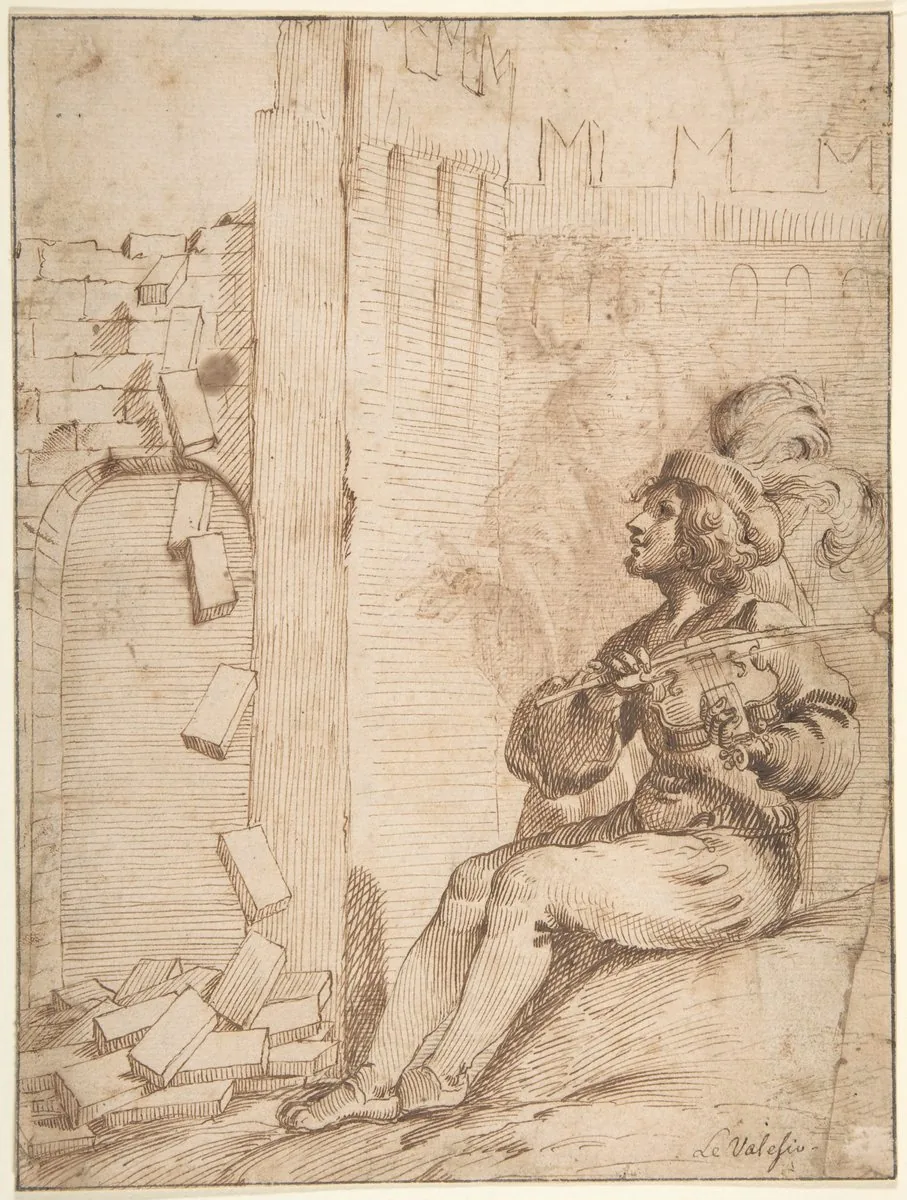
A pen and brown ink drawing by Giovanni Luigi Valesio at the Metropolitan Museum is titled Amphion Building the Walls of Thebes. Created long after antiquity, it turns the musical marvel into a visible scene of construction. It is neither an ancient building record nor a replacement for Zethus’ role in the texts. Its title can lead us back to Homer’s plain requirement: heroes too need a protected place to live. We may therefore read music as an ability that helps shared life become possible. This interpretation does not need to prove it superior to strength; it brings different capacities toward one concrete goal. Stone settles into the wall, while sound remains in the memory of how the city came to be.