A shore that refuses to become a refuge
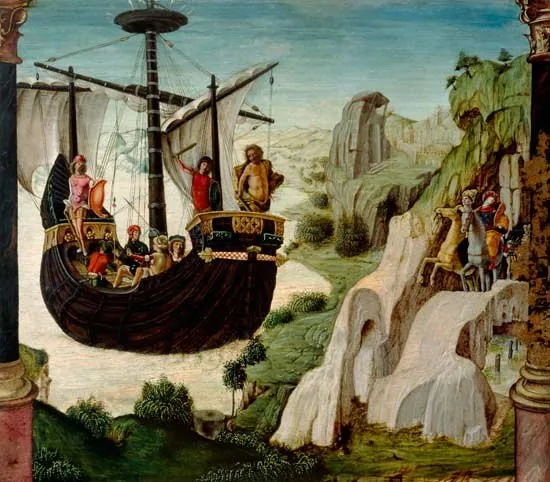
Near the end of Apollonius’ Argonautica, Crete appears before sailors who have already endured a long return journey. Yet land does not immediately promise safety. Talos tears rocks from the cliff and keeps the Argo from securing its mooring ropes. The men need water and rest, while the island has a guardian whose task is to keep arrivals away. Apollonius describes him as the surviving member of a bronze race and says that Zeus gave him to Europa to guard Crete, circling it three times each day. That repeated circuit makes protection visible as a routine. From the ship, however, the same routine becomes an obstacle. The episode begins with two needs occupying the same coastline, rather than with an invitation to admire an enormous body.
Bronze does not mean everlasting life
Most of Talos’ body is bronze and cannot be wounded, but a red vein near his ankle lies beneath a thin covering of skin. The contrast unsettles the impression of a completely sealed figure. His strength depends on something that the strongest material around it does not fully protect. Medea notices another distinction: a body made of bronze need not possess an everlasting life. She offers to confront him if the crew will remain beyond the range of his stones. This is not yet the discovery of a removable mechanical part. In Apollonius, the ankle is a living boundary between endurance and death. We can read the scene as a question about what strength depends upon. Medea sees a difference between enduring blows and possessing endless life, and that difference matters before she makes any move.
An attack across the water
The crew holds the ship offshore, and Jason helps Medea across the benches. She covers her cheeks with her purple robe, kneels, and invokes death spirits through repeated songs and prayers. Her hostile gaze is directed toward Talos while the sailors wait. The poem shifts attention from the force of thrown stones to a threat that crosses distance without touching its target. As the guardian lifts more rocks, he grazes his ankle against a sharp crag and loses the ichor that sustains him. Apollonius compares his collapse to a tall pine left partly cut through, which finally breaks under the wind. The comparison gives his fall duration and weight. Even after its weakness is exposed, this formidable body does not simply stop being impressive.
The nail belongs to another telling
The Bibliotheca preserves a different arrangement of possibilities. It reports both a bronze-race origin and a tradition connecting Talos with a gift from Hephaestus to Minos; it even notes a form described as a bull. Here a single vein runs from neck to ankles and ends at a bronze nail. The account offers several deaths: Medea brings madness through drugs, or promises immortality and removes the nail; another telling credits an arrow shot by Poeas. These alternatives should remain alternatives. Combining a spell, a deliberate extraction and an arrow into one elaborate attack would erase the compiler’s useful signals of disagreement. The differences change the scene’s questions, from the reach of a distant gaze to trust in a promise and the possibility of being deceived about one’s own survival.
A name with more than one ancestry
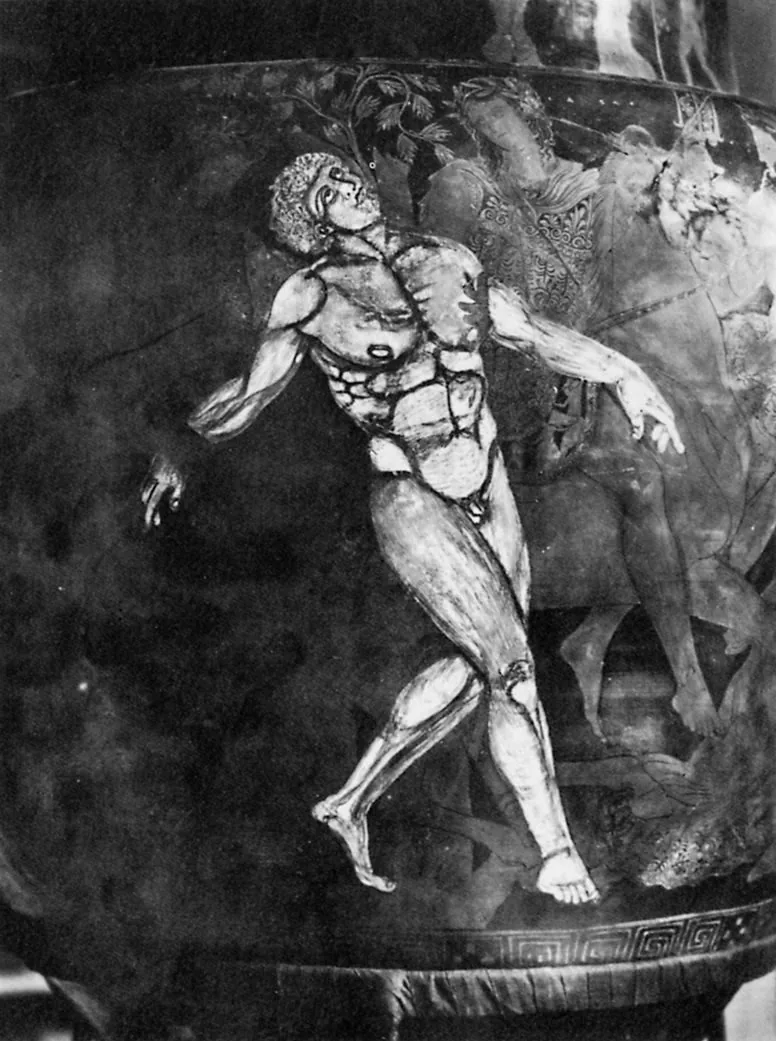
Pausanias supplies a further reminder about names when he reports Cinaethon’s genealogy: Talos is a son of Cres and the father of Hephaestus. This cannot quietly become one family tree alongside the account in which Hephaestus gives Talos to Minos. The traveller himself observes the variety of Greek genealogical traditions. The accompanying historical photograph shows ancient vase painting; it cannot serve as a literal illustration of every detail in either written account. Holding that variety in view lets us return to the shore with better questions. What is the guardian protecting, and who cannot pass? What remains vulnerable inside an apparently overwhelming strength? Medea makes landing possible, but Talos’ fall is still a death within the poem. The bronze surface does not remove that cost. Reading slowly preserves the encounter’s tension between necessary refuge, defended territory and a life whose limits become visible too late.