A promise to finish in one day
Augeas owns a great herd, and the accumulated filth in its stables becomes a new task assigned by Eurystheus. The Bibliotheca says Heracles does not initially reveal that he acts under orders. Instead, he agrees with the cattle’s owner that cleaning the stables within a day will earn him a tenth of the herd. Augeas accepts, believing it impossible. Heracles asks the king’s son Phyleus to witness the agreement before beginning the work. The story does not dismiss cleaning as a trivial activity: deadlines, quantities, and witnesses underpin the later dispute, while the value of labor enters the negotiation from the outset.
Strength changes the rivers’ course
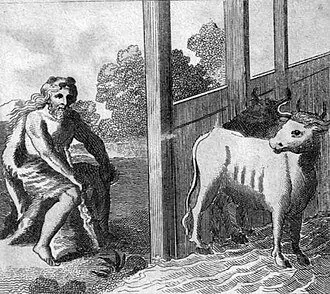
Heracles opens a gap in the stables’ foundations to admit water from the Alpheus and Peneus, then provides another opening for the waste to flow out. Rather than removing manure shovel by shovel, he changes the work’s scale so that running water does most of the cleaning. Diodorus likewise connects this labor with his ingenuity, but the river names and details must be established from each account. Later paintings often fill their scenes with a broad river and a figure moving rocks. Such visual amplification can explain the method, but is not archaeological evidence that the ancient waterworks actually existed.
Successful cleaning, disputed recognition
On learning that Heracles is performing Eurystheus’ task, Augeas refuses to pay and denies having promised a reward. Phyleus testifies for the hero, but is expelled from Elis along with him. Eurystheus also refuses to count the labor among the ten tasks because Heracles sought payment. Two kings reject the same work for opposite reasons: one uses the assigned task to deny a reward, while the other uses the reward to deny its standing as a task. Preserving this contradiction does more than show that ingenuity can outperform brute force; it reveals the distance between accomplishment and judgment. The witness matters especially: he has not cleaned the stables, yet loses his place at home by acknowledging the agreement. Truthful testimony also has a cost.